Ti Boug: the real market price in every Réunion pocket
Ti Boug is my iPhone app against the high cost of living in Réunion Island. The promise fits in one Creole line: “Sak lé bon marché, ousa é kansa” — what’s cheap, where, and when.

I’ve already told the story of where the project starts: wasted public data, stuck in PDFs nobody reads. Here I’m presenting the app itself — what it does, what it’s built with, and where I am.
The problem: the cost of living, one vegetable at a time
In Réunion, the price gap with mainland France on food is real and weighs on purchasing power. And from one week to the next, one market to another, fruit & veg prices swing hard. The good info exists — the official DAAF bulletins — but nobody has it in their pocket when it’s time to hit the market.
That’s exactly the gap Ti Boug fills: pull that data out of the PDF and make it readable at a glance, before you go shopping.
What the app does
Ti Boug answers three questions, across three screens.
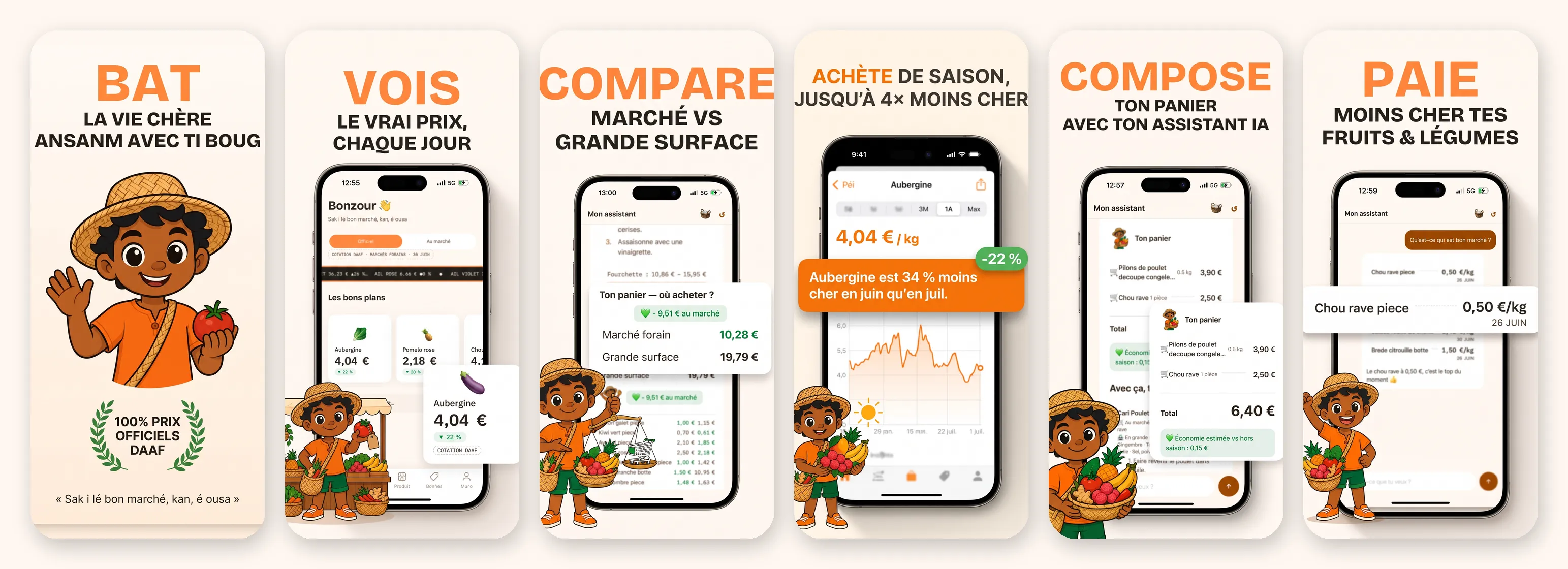
- What’s cheap today? The daily board (“Bazar du jour”): each fruit & veg, its price, its trend and the real bulletin date. Buyer-side inverted semantics: a falling price shows in green.
- When should I buy? Seasonality, derived from the price history. Lychee in December, not March — up to 4× cheaper. A 12-month curve and a “peak season” badge when the price collapses.
- How do I build a smart basket? The AI market assistant: give it your budget, it composes a basket from the real prices of the day and the season, and suggests local recipes.
Honest by design
One non-negotiable: DAAF data lags by several weeks, and it’s an official quotation, not the exact price at your till tonight. So the bulletin date is always shown, on the home and on every card. A purchasing-power app that lies about its data has already lost. I detailed that principle — and the objections I put to myself — in the origin article.
The stack
One dev, so a stack that moves fast and doesn’t let me down:
- React Native + Expo (SDK 54), strict TypeScript, Expo Router — iOS-first for build speed.
- Convex for the backend: reactive database, server functions, auth (Apple / Google / email), storage and crons. A daily cron fetches the new bulletins and kicks off the pipeline.
- The data pipeline: the cron follows the PDF links, has an LLM read them into strict Zod-validated JSON, normalises labels to a canonical product, and archives every quotation append-only.
- Vercel AI SDK in multi-provider mode (Gemini by default, Claude / OpenAI optional) for PDF parsing, the tool-calling basket assistant, and report OCR.
- RevenueCat for the Premium subscription.
Where the build stands
The app is in the finishing stretch: the three screens run on real DAAF data, the pipeline ingests the bulletins every day, and I’m preparing the App Store submission (iOS-first — the architecture doesn’t block Android later). The landing page is live at tiboug.re.
I’ll keep telling the rest here. Build in public.
Data source: DAAF Réunion price bulletins — etalab 2.0 licence.